Most Americans Can't Afford to Attend the NBA Finals
71% of U.S. households can't afford nosebleed seats — up from 24% in 1994
The NBA Finals have become unaffordable for most Americans
The NBA Finals are one of the most-watched sporting events in America — but for most families, attending in person is simply out of reach. My analysis finds that 71% of U.S. households can’t afford even the cheapest nosebleed seats to the NBA Finals today. In 1994, that number was just 24%.
- 71% of U.S. households can’t afford nosebleed seats at the 2026 NBA Finals.
- In 1994, only 24% of U.S. households were priced out of the same seats.
- That’s nearly a tripling of unaffordabilty in three decades.
The chart below shows how sharply the unaffordabilty of nosebleed seats has increased since 1994.
The racial divide is even starker
The aggregate numbers are striking, but they mask even deeper disparities by race. Black and Latino families are largely shut out of the NBA Finals — an event in which Black players make up the overwhelming majority of athletes.
- 87% of Black households and 86% of Latino households can’t afford nosebleed seats in 2026.
- In 1994, 51% of Black households and 46% of Latino households were priced out.
- Even white households have seen a dramatic decline: unaffordability has risen from 18% to 68%.
Why this matters
The NBA has deep roots in Black American communities. The league’s players are predominantly Black, its cultural influence on music, fashion, and identity is undeniable — and yet the people who built that culture are increasingly priced out of experiencing it live. This is what economic exclusion looks like in practice: a sport that draws on Black talent and culture has become, for most Black families, something you watch on television rather than in person.
More broadly, the NBA Finals are a microcosm of a wider story: the experiences and events that define American culture and society are steadily becoming the exclusive province of the wealthy. Working families have been squeezed out of mainstream activities.
The takeaway here is one you’ll read frequently at In Our Economy: We’re living in an economy shaped by and for the wealthiest. Even people who are working hard and doing everything right are priced out of experiences that used to be within reach.
Methodology and sources
This analysis compares ticket prices at NBA Finals events at Madison Square Garden in 2026 to 1994. To determine whether a household could afford tickets, I analyzed raw microdata from the 1994 and 2022 Survey of Consumer Finances (SCF), conducted by the Federal Reserve Board. A household was defined as unable to afford a ticket if the cost of nosebleed seats for all adults and children in the primary economic unit exceeded the household’s total checking account balances. All 1994 and 2026 prices were converted to 2022 dollars for comparison. Because wages and savings have not fully kept pace with recent inflation, these estimates likely underestimate current unaffordability.
The data were analyzed in R using Thomas Lumley’s survey and mitools packages. Special thanks to Antony Damico for the multiple imputation function used with the SCF.
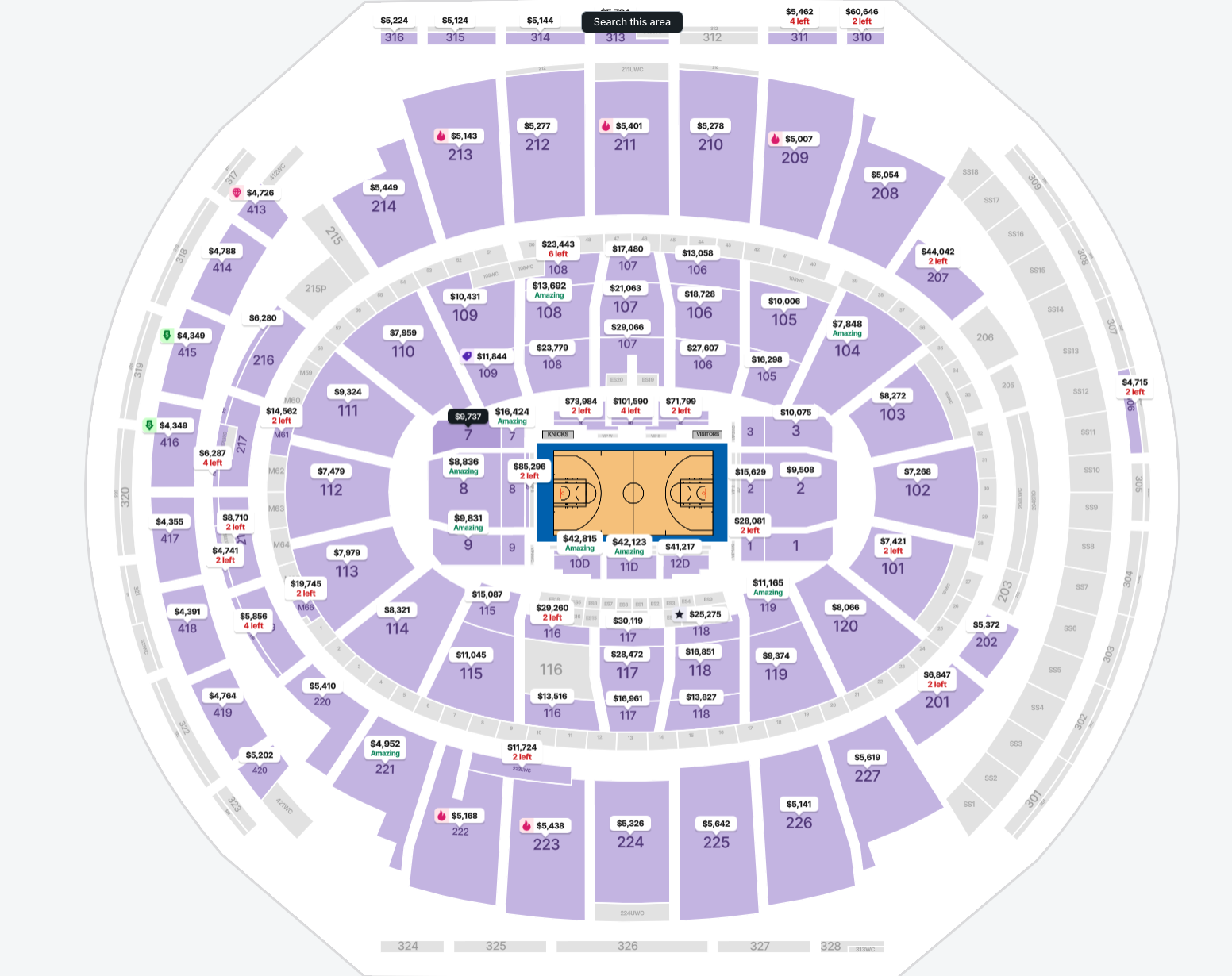
For ticket prices, I used the cheapest available nosebleed seats. For game one in 2026, this was $4,391. Prices for the 1994 Finals are from Nina Prater’s reporting in New York Magazine
Those interested in confidence intervals can see the full estimates below.
The visualizations above are built with the JavaScript library Observable Plot. There are no trackers.
Comments
Comments may take a while to appear. I have to approve each one. I wish that weren't the case, but it's the tradeoff for using a an ad-free, privacy-focused comment app.